
Scalloway’s harbour and roofless castle offer a starting point for understanding Shetland. The village’s story connects ancient settlement, Norse government, Scottish earls and wartime voyages to Norway. Looking beyond its waterfront reveals how closely the history of these islands has been shaped by the sea.
Before the castle: prehistoric Shetland
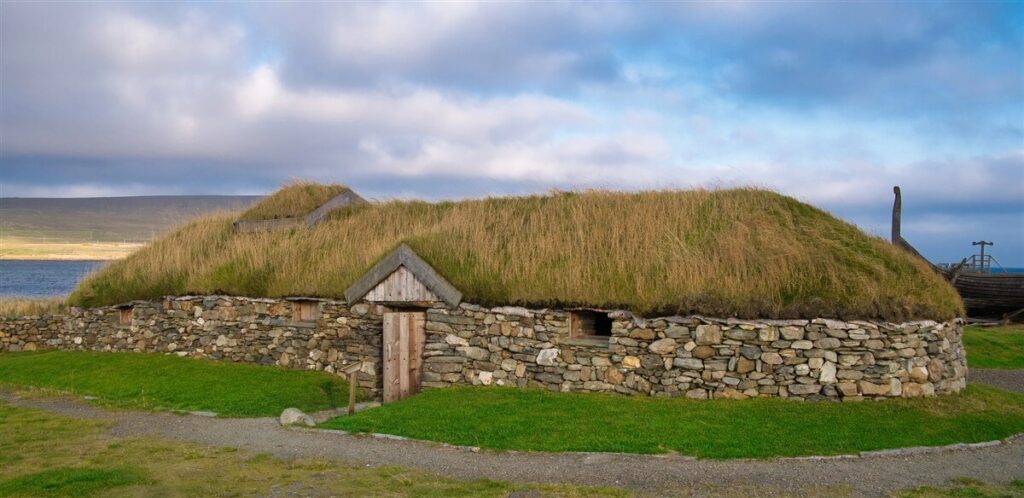
Shetland’s past stretches much further back than its familiar Viking associations. At Jarlshof in the South Mainland, successive communities left buildings from the late Neolithic period through to the seventeenth century. Bronze Age houses, an Iron Age broch, wheelhouses and Norse longhouses occupy the same remarkable site. Historic Environment Scotland’s account of Jarlshof explains this long sequence of settlement.
Scalloway also has an ancient past. Excavations north of the present village revealed an Iron Age broch and evidence of Bronze Age occupation. The castle is therefore one chapter in a much longer history of people making homes beside this sheltered water.
Norse Shetland and the Tingwall connection
Norse settlement connected Shetland closely with Norway. At Jarlshof, settlers from Norway established a farm in the ninth century. Near Scalloway, the lawting at Tingwall was a meeting place for interpreting laws and administering justice. The assembly later moved into Scalloway in the sixteenth century.
These connections help explain why a history of Scalloway reaches beyond the village itself. Tingwall, the harbour and the castle belong to a wider landscape of settlement and government. Promote Shetland’s history of the village traces those links.
How Shetland became part of Scotland
Two dates matter here. In 1469, Christian I of Denmark-Norway pledged Shetland to James III of Scotland as security for his daughter Margaret’s dowry. Orkney had been pledged the previous year. In 1472, James annexed both island groups to the Scottish crown.
As Shetland Museum and Archives explains, the transition involved changes in royal and church administration, while some older local institutions continued. It was a process, rather than a moment in which every aspect of island life changed overnight.
Earl Patrick and Scalloway Castle
Scalloway’s most conspicuous historic building dates from 1599. It was built for Patrick Stewart, earl of Orkney and Shetland, whose oppressive rule made him notorious. Historic Environment Scotland records accusations that forced labour was used in its construction. Patrick was executed in Edinburgh in 1615.
The tower house is impressive, but its story also raises questions about who held power and who paid the price. Our Scalloway Castle guide explores that history. The castle is currently closed for conservation: check the official visitor information before planning a visit.
From former capital to working harbour
Scalloway’s description as Shetland’s former capital reflects its historic administrative importance. As Lerwick grew, commerce and government increasingly shifted east. Scalloway continued as a fishing centre and a place serving the surrounding communities. Its history did not end when its political prominence diminished.
The Shetland Bus and Norway
During the Second World War, the Shetland Bus carried agents and supplies to occupied Norway and brought people back across the North Sea. Despite the name, this was a maritime operation. Its operational base moved from Lunna to Scalloway in 1942.
Fishing boats initially made the dangerous crossings; three submarine-chasers later took over. The memorial in Scalloway records the 44 crewmen who died. Scalloway Museum’s account places these journeys and the friendships they created at the centre of the story.
Exploring the history today
Begin with the waterfront and the castle exterior, then visit the museum when open. Our museum and Shetland Bus guide provides more context. For a wider view of the islands, combine Scalloway with Shetland Museum and Archives in Lerwick and the archaeology of the South Mainland. Allow time to follow a particular interest rather than trying to fit every period into one afternoon.
Explore more of Scalloway and Shetland
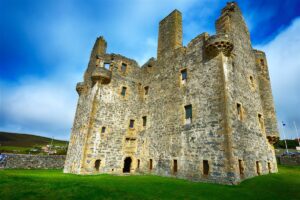
Scalloway Castle is a striking part of the village’s skyline. Its surviving stone walls also tell a less comfortable story: one associated with authority…
